Ophthalmology Software: Sharing is Caring
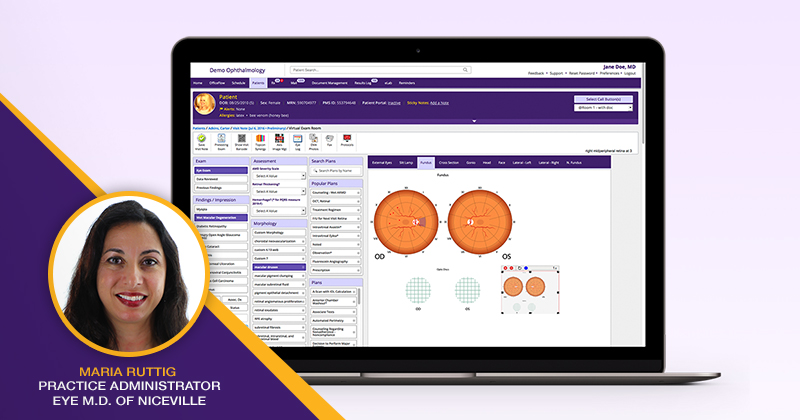
How ophthalmology EMRs help us efficiently share information with providers and payors
Key takeaways
- Adopting an integrated, cloud-based ophthalmology EMR system provides significant operational, financial, and clinical advantages.
- Streamlines clinical communication: Seamlessly share notes with referring physicians and payors.
- Optimizes revenue cycle and billing accuracy: Combines integrated RCM with auto-suggested procedure codes in the cloud ophthalmology EMR to automate claims and speed up coding.
- Eliminates paper records: Converts incoming faxes directly into digital chart PDFs within the cloud EMR, removing physical storage and dedicated records staff.
- Helps protect data and simplifies IT: Cloud-based software is designed to help safeguard data against disasters while eliminating local server maintenance.
- Enables flexible remote access: Gives physicians mobile access to the cloud ophthalmology EMR to chart, e-prescribe, and log notes from home.
Hear how Maria Ruttig, Practice Administrator, Eye M.D. of Niceville, uses ModMed to help eliminate paperwork, improve billing and operations, streamline workflows, improve team coordination, and save time.
Located in Florida’s Panhandle, Eye M.D. of Niceville focuses on general ophthalmology, bringing advanced medical and surgical eye care to about 40 patients per day in the community. They employ one comprehensive ophthalmologist, plus a staff of 8, who handle a patient volume of almost 40 visits per clinical day, 20 cataract surgeries per week, and up to two eyelid surgeries per week.
Maria Ruttig, practice administrator, shares their experience using ModMed’s ophthalmology electronic health record (EHR) system, EMAⓇ, with Merit-based Incentive Payment (MIPS) reporting, and ModMedⓇ Practice Management (PM). A user-friendly system coupled with a responsive support team helped set the practice up for success.
Being able to share a patient’s protected health information with other providers and payors quickly and efficiently is critical in today’s healthcare environment. A cloud-based ophthalmology electronic medical record (EMR) system enables us to do just that in far better ways than relying on a paper-based system.
Say “goodbye” to paper
We have been using the ophthalmology EMR system from ModMed since we opened. Shortly after we went live, they began offering ophthalmology practice management directly integrated with the EMR system. We asked our team if it was something that would benefit the practice, and the answer was a unanimous: “Yes! We hate paper!”
Quite frankly, I wasn’t surprised. I have seen practices with an entire room filled with paper medical charts that employed a full-time records person to manage them all. That simply wasn’t going to work for our practice.
Sharing information with ease
Like most ophthalmology practices, we must often share clinical notes or continuity of care information with other providers. This is especially true with retina specialists, as we share a number of mutual patients.
We also need to ensure primary care doctors who refer patients to us are kept up to date on their patients’ care. If we were a “paper-based” practice, sharing information with other providers would pose an extreme burden to our staff.
Thanks to ModMed’s revenue cycle management services, we don’t have to share data with most payors for reimbursement — the outsourced team manages our revenue cycle from before the appointment through full claim and patient adjudication.
We are located near a large US Air Force base, and many of our patients are TRICARE members. The product supported by the revenue cycle team can share visit notes directly via e-fax or direct messaging.
Built-in ophthalmology coding suggestions
In addition to the convenient information-sharing capabilities, our ophthalmology EMR system’s built-in suggested coding is also a great advantage. The system suggests users enter data based on the procedure(s) the physician actually performed and determines the code based on the relevant criteria. The physician then selects the appropriate code for billing.
No more file storage
In addition, our electronic fax service means we receive faxes as PDFs, which can be easily uploaded to the ophthalmology EMR system directly into the patient’s chart. And not having paper charts means we don’t need large file cabinets!
Advantages of a cloud-based EMR system
Another vitally important perk: Our EMR and ophthalmology practice management systems are based entirely on cloud technology, which has multiple benefits. For one, we don’t need to house and maintain our own server, and we don’t need to worry about software updates — it’s all virtually out of sight, out of mind. In addition, we’re in a hurricane zone, and it’s a huge relief to know there’s a much lower chance the system will go down, or we’ll lose patient data during a natural disaster.
Being in the cloud also makes the system easily accessible; our doctor can finalize charts from the comfort of his home. If patients call after hours and need a prescription, he can easily fill them electronically and make a quick progress note in their charts. This is an especially important component for MIPS.
In general, our practice appreciates the convenience of having a cloud ophthalmology EMR system to improve communications with other providers and payors. Having the right technology in place is worth the investment to run a successful practice.
Ready to build a more efficient ophthalmology practice? Book a demo to discover how ModMed can support your practice goals.
FAQs
What are the benefits of a cloud-based EHR for an ophthalmology practice?
A cloud-based ophthalmology EHR streamlines provider and payor communication while eliminating the physical storage and IT maintenance required for paper charts and on-site servers. It also offers built-in coding suggestions and secure remote access, allowing physicians to easily finalize charts and handle e-prescriptions after hours.
How do ophthalmology practices share records with referring providers and payers?
Ophthalmology practices share clinical notes and continuity of care data with referring providers and military payers using built-in direct messaging and e-fax capabilities. For billing, integrated revenue cycle management services manage claim adjudication directly with payers, eliminating the need for staff to manually transmit records for reimbursement.
How does an ophthalmology EHR suggest codes for procedures like cataract surgery?
An ophthalmology EHR auto-suggests billing codes by evaluating the clinical details documented during the encounter, such as the specific surgical technique, operative findings, and relevant procedure criteria. The system matches this documented data against built-in coding logic to present corresponding CPT and ICD-10 suggestions, which the physician then reviews and approves to finalize for billing.
This blog is intended for informational purposes only and does not constitute legal or medical advice. Please consult with your legal counsel and other qualified advisors to ensure compliance with applicable laws, regulations, and standards.