




Structured real-world data to drive life science and outcomes research
Eliminate the delay between data and discovery
Clinical data without the cleanup
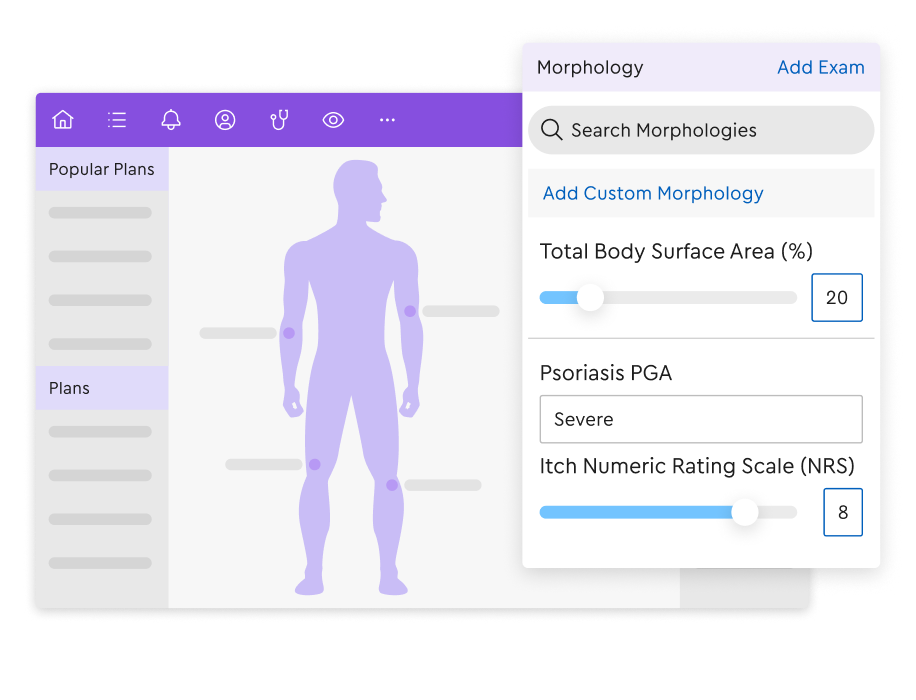
Breakthrough research shouldn’t stall because you have to spend months untangling free-text clinical notes before running a query. ModMed® Real-World Data (RWD) Solutions delivers de-identified, tokenized datasets ready for use. Because we capture every granular detail as structured data right in the exam room, there are no messy narratives to decipher.
Whether you are generating real-world evidence, conducting outcomes research, or running life sciences analyses, ModMed provides organized datasets so you can stop cleaning data and get straight to the insights.
The ModMed RWD Solutions data advantage

Structured and de-identified
Bypass messy, unstructured narratives with data that is primed for clinical and operational modeling. ModMed equips your researchers with anonymized, highly structured data captured directly at the point of care.

Specialty-specific and granular
Power your most complex research with specialty-specific datasets captured at the granular level. With it, you get the variables needed to analyze rare and common disease populations, track outcomes, and measure real-world product use.

Longitudinal and tokenized
Build reliable real-world evidence by following patients across multiple visits. Tokenized longitudinal continuity allows researchers to see the complete context, measure true clinical progression, track operational decisions over time, and accurately assess long-term patient outcomes.
Real-world data for real-world impact
Help accelerate clinical trials, streamline regulatory submissions, and improve patient outcomes using our analytics-ready, specialty-specific datasets.
Pharmaceutical Manufacturers
Emerging BioPharma
MedTech and Diagnostics
Government and Public Health
Health Systems and Academic Research
Health Economics and Outcomes Research (HEOR)
Help prove the long-term clinical and economic value of a therapy — essential for pricing and reimbursement negotiations — using structured outcomes from over 1 billion patient encounters.
Real-World Evidence (RWE)
Track post-approval drug performance and long-term safety from structured EHR outcomes. This RWE can help satisfy regulatory requirements and successfully secure label expansions.
Competitor Performance
Analyze real-world data to demonstrate superior efficacy against existing standard-of-care treatments.

Investor Relations and Valuation
Generate evidence-backed patient population sizing to strengthen fundraising narratives and board confidence prior to key financing rounds.
Clinical Development and Feasibility
Evaluate trial feasibility and pinpoint target patient concentration across specialty indications.
Commercial Launch Planning
Sequence go-to-market strategy using prescriber concentration data before building out commercial infrastructure.

Regulatory Submissions and Surveillance
Support the generation of RWE designed to inform medical device submissions and assist with post-market safety monitoring aligned with FDA guidance.
Market Access and Reimbursement
Build clinical outcome and utilization evidence to support CPT coding, coverage decisions, and payer contract negotiations.
Commercial and Procedure Tracking
Track specialist adoption curves and longitudinal procedure volumes across specialty medical care settings.

Regulatory Review and Policy Support
Inform regulatory evaluations and national and local coverage determinations using real-world specialty outcomes.
Health Equity and Public Surveillance
Track specialty chronic disease trends and access disparities across demographic and geographic subgroups.
Safety Monitoring
Give agencies the ability to use real-world data for post-market safety monitoring, track adverse events, and help support the approval process for new treatments.

Clinical Quality Improvement
Use real-world outcomes data to design population health and care coordination interventions for specialty patient groups.
Research
Conduct retrospective observational studies and disease burden research using structured specialty EHR data beyond controlled trial populations.
Improving Access and Delivery
Apply research-ready RWD to help drive operational efficiency and improve patient engagement, care quality, and overall health outcomes.

Pharmaceutical Manufacturers
Health Economics and Outcomes Research (HEOR)
Help prove the long-term clinical and economic value of a therapy — essential for pricing and reimbursement negotiations — using structured outcomes from over 1 billion patient encounters.
Real-World Evidence (RWE)
Track post-approval drug performance and long-term safety from structured EHR outcomes. This RWE can help satisfy regulatory requirements and successfully secure label expansions.
Competitor Performance
Analyze real-world data to demonstrate superior efficacy against existing standard-of-care treatments.
Emerging BioPharma
Investor Relations and Valuation
Generate evidence-backed patient population sizing to strengthen fundraising narratives and board confidence prior to key financing rounds.
Clinical Development and Feasibility
Evaluate trial feasibility and pinpoint target patient concentration across specialty indications.
Commercial Launch Planning
Sequence go-to-market strategy using prescriber concentration data before building out commercial infrastructure.
MedTech and Diagnostics
Regulatory Submissions and Surveillance
Support the generation of RWE designed to inform medical device submissions and assist with post-market safety monitoring aligned with FDA guidance.
Market Access and Reimbursement
Build clinical outcome and utilization evidence to support CPT coding, coverage decisions, and payer contract negotiations.
Commercial and Procedure Tracking
Track specialist adoption curves and longitudinal procedure volumes across specialty medical care settings.
Government and Public Health
Regulatory Review and Policy Support
Inform regulatory evaluations and national and local coverage determinations using real-world specialty outcomes.
Health Equity and Public Surveillance
Track specialty chronic disease trends and access disparities across demographic and geographic subgroups.
Safety Monitoring
Give agencies the ability to use real-world data for post-market safety monitoring, track adverse events, and help support the approval process for new treatments.
Health Systems and Academic Research
Clinical Quality Improvement
Use real-world outcomes data to design population health and care coordination interventions for specialty patient groups.
Research
Conduct retrospective observational studies and disease burden research using structured specialty EHR data beyond controlled trial populations.
Improving Access and Delivery
Apply research-ready RWD to help drive operational efficiency and improve patient engagement, care quality, and overall health outcomes.
Robust nationwide specialty representation
ModMed maintains extensive data across the dermatology and ophthalmology specialties, with a growing network that continues to expand. Captured at a granular level in structured fields within our award-winning EHR1 and delivered in an analysis-ready format, our data supports life sciences organizations working on real-world evidence (RWE), and health economics and outcomes research (HEOR), and more.
Dermatology
Ophthalmology
ModMed RWD Solutions provide extensive dermatology data2, such as:
| Disease | Estimated patient count | Key outcome measures |
|---|---|---|
| Psoriasis | 4.5M | Location, PGA, BSA, Itch-NRS, PASI |
| Atopic Dermatitis | 5.9M | Location, overall assessment, BSA, Itch Index, EASI |
| Hidradenitis Suppurativa | 750K | Location, Hurley stage |
| Alopecia Areata | 820K | Location, severity score |
| Melanoma | 1.1M | Location, stage, lesion diameter |
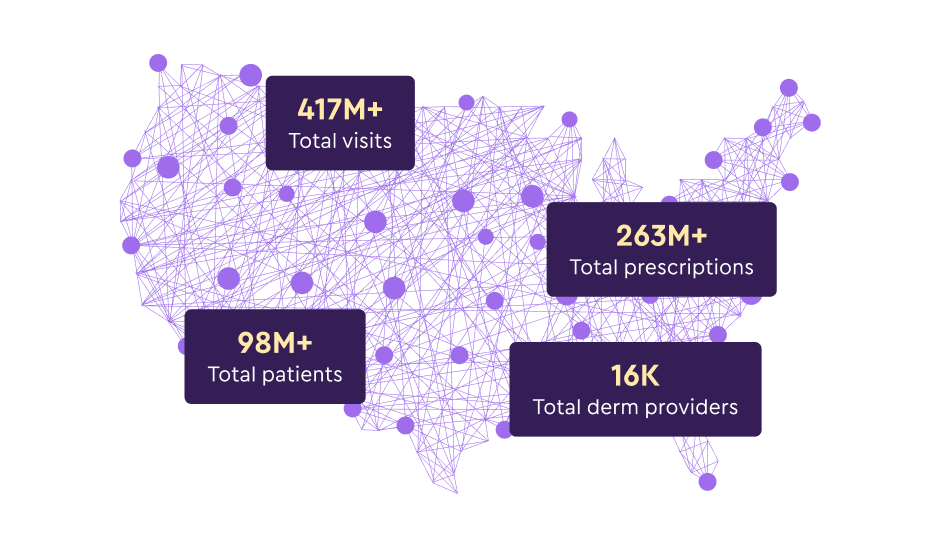
Dermatology
Extensive data from our network of:
- 98M+ patients
- 481M+ encounters
ModMed RWD Solutions provide extensive ophthalmology data2, such as:
| Disease | Estimated patient count | Key outcome measures |
|---|---|---|
| Dry Eye | 5.8M | Schirmer’s test, tear breakup time, tear film osmolarity |
| Glaucoma | 1.7M | Visual acuity, visual field test, IOP |
| Dry AMD | 1.2M | Visual acuity, IOP |
| Wet AMD | 340K | Visual acuity, IOP |
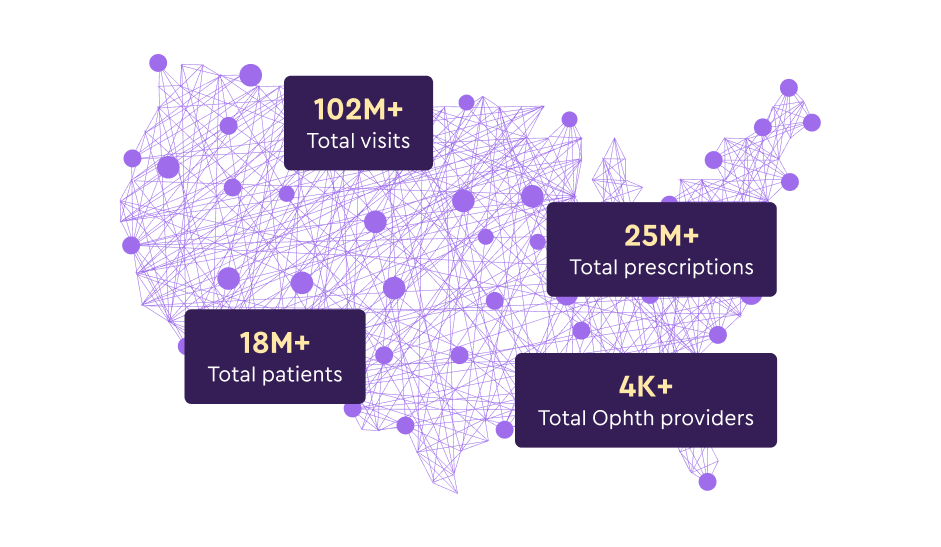
Ophthalmology
Extensive data from our network of:
- 18M+ patients
- 102M+ encounters
Explore ModMed RWD Solutions

Get to know ModMed
#1 EHR
#1 dermatology EHR for 13 years in a row1
#1 ophthalmology EHR for 10 years in a row1
~1B
Patient encounters across 11 specialties
Technology Team of the Year
2025 Stevie American Business Awards (Silver)
FAQs
What is de-identified clinical data?
De-identified clinical data is patient health information that has had direct identifiers removed to help protect privacy. In research, it allows organizations to analyze treatments, outcomes, and disease patterns without exposing personally identifiable patient information.
How is real-world data collected from EHR systems?
Real-world data from EHR systems is collected during routine patient care and captured in clinical fields such as diagnosis, body location, disease severity, treatment history, and outcome measures. Structured, de-identified EHR data is especially useful because it is more consistent and ready for analysis.
What is structured EHR data, and why does it matter for research?
Structured EHR data is information recorded in standardized fields, directly input from questions the specialist answers, rather than unstructured narrative text. It matters for research because it improves consistency of the data content entered by the specialist, supports faster analysis, and makes it easier to evaluate patient outcomes, treatment patterns, and disease progression at scale.
How can de-identified, tokenized patient data support real-world evidence studies?
De-identified, tokenized patient data can support real-world evidence studies by enabling researchers to analyze outcomes while helping protect privacy. Tokenization can also facilitate patient-level linkage across disparate datasets to support HIPAA compliance, creating a broader view of patient journeys, treatment use, and longitudinal outcomes.
What types of outcome measures can specialty-specific real-world data include?
Specialty-specific real-world data can include outcome measures such as disease severity scores, body location, visual acuity, intraocular pressure, lesion characteristics, symptom indexes, and progression over time. These structured measures help researchers evaluate disease burden, treatment response, and clinical outcomes.
Why do life sciences teams use specialty-specific clinical datasets?
Life sciences teams use specialty-specific clinical datasets because they provide deeper clinical context than many generalized sources. These datasets can offer disease-relevant measures, treatment insights, and outcome details that improve study design, evidence generation, and therapeutic area analysis.
What is the difference between real-world data and real-world evidence?
Real-world data refers to health information collected during routine care, sourced from EHRs, claims, or outcomes data. Real-world evidence is the clinical or scientific insight generated by analyzing real-world data to answer questions about treatment use, safety, effectiveness, or patient outcomes.
The scale and granularity of ModMed Real-World Data Solutions help drive more accurate real-world evidence for life science researchers.
What should researchers look for in a real-world data provider?
Researchers should look for data quality, structured fields, specialty relevance, privacy protections, tokenization capabilities, geographic breadth, and outcomes depth. A strong real-world data provider should also deliver analysis-ready datasets that align with the intended research question and study design.

Contact us to get started
Rick Catino
Vice President, Real-World Data
ModMed
1 2026 Black Book™
2 Data reflected are sample estimates. Patient counts may vary depending on inclusion parameters and terms.